 KA
KA EN
EN RU
RU

 Back to Blog
 August 21, 2026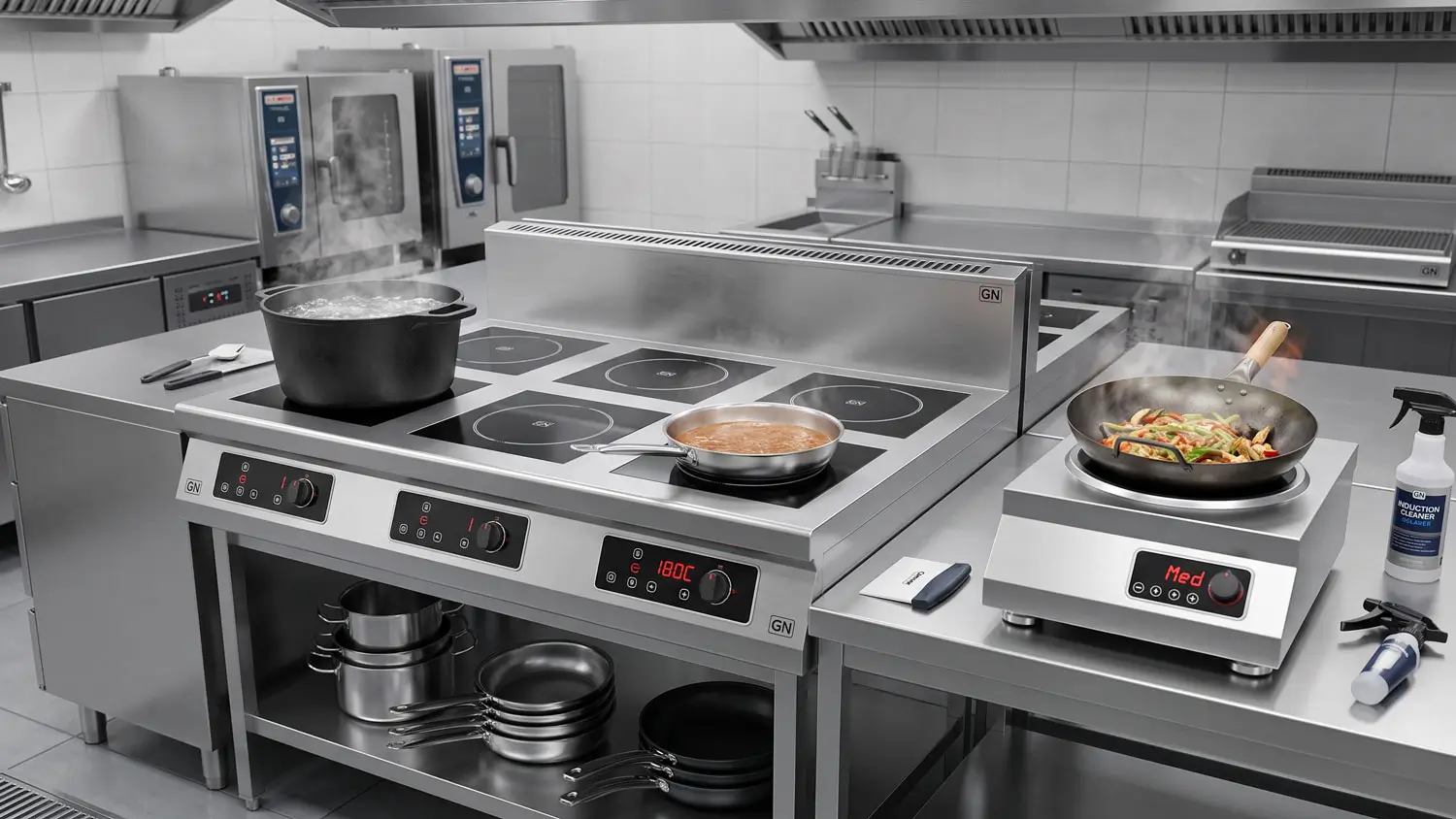
Success in the modern HORECA industry (hotels, restaurants, cafés) no longer depends on tasty dishes alone. Today what decides it is speed, energy efficiency, comfort for the staff and keeping operating costs down. That is exactly why the induction cooktop is no longer merely a “modern trend” — it has become the new gold standard of the professional kitchen.
If our previous article looked at why chefs prefer induction to traditional gas, this larger guide goes into more detail. We will talk about the return on investment (ROI), look at real cases, teach you how to care for the appliance properly and help you pick exactly the model from the GN.GE catalogue that fits the specifics of your business perfectly.
1. How does an induction cooktop save money? (ROI analysis for a restaurant)
When buying professional equipment, a smart restaurateur looks not only at the initial price but at the TCO (Total Cost of Ownership). Let us break down in figures why an induction cooktop is financially profitable.
- Minimising heat loss (90% vs 40%): When a traditional industrial gas range is used, only 40-50% of the energy goes into heating the pan or pot itself. The other 50% disperses into the air and heats the kitchen. An induction cooktop directs 90% of the energy straight to the base of the pan. You pay only for the electricity that goes into cooking the dish.
- Air-conditioning and ventilation costs (HVAC): A gas range gives off an enormous amount of heat and carbon dioxide. That calls for powerful, expensive extraction systems and continuous air conditioning of the kitchen in summer. With induction cooktops the kitchen temperature is on average 4-5 degrees lower, which directly reduces the electricity bill for cooling.
- Cooking time (Time is Money): Water boils 50% faster on induction than on gas. During peak hours, when the dining room is full, every minute is worth gold. Faster table turnover means more revenue.
2. How to choose an induction cooktop from the GN.GE catalogue (areas of use)
The concept of your venue directly determines which model you will need. Our catalogue covers every need in the HORECA sector.
Category A: small cafés, bars, bistros and live cooking stations
If you have a small space where only breakfasts, sauces or quick snacks are prepared, compact models are ideal. They take up little room and are ready for intensive work.
Recommended models:
- Induction Cooktop with 1 Burner IND-001 Ideal for a limited space or as an auxiliary surface.
- Induction Stove IND-01 A standard, solid and dependable model for bars.
- Two-Zone Induction Cooktop IND-02 The best balance between price and output for a small kitchen.
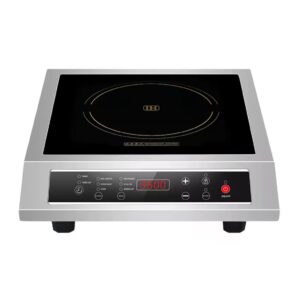
Induction Cooktop with 1 Burner IND-001
Code: GN10331
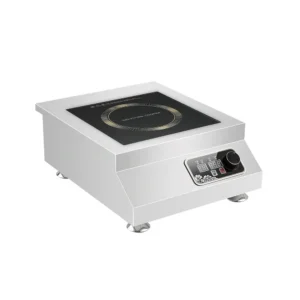
Induction Stove IND-01
Code: GN10330
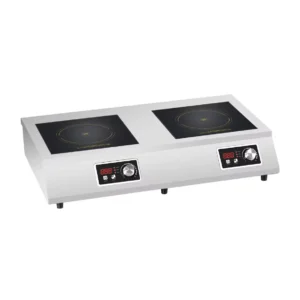
Two-Zone Induction Cooktop IND-02
Code: GN10329
Category B: Asian, fusion and quick-service restaurants (WOK)
Asian cuisine is unthinkable without a wok. Traditional gas wok ranges give off an enormous flame, which is often a fire hazard. An induction wok has a specially recessed surface so that it fits the wok pan perfectly and distributes the heat evenly up its walls.
Recommended models:
- Induction wok cooktop with 1 burner IND-002 (code: GN10321 | 355 ₾): An excellent start for small noodle bars.
- Induction wok cooktop IND-W (code: GN10320 | 420 ₾): For professional loads, to obtain the maximum “Wok Hei” (breath of the wok) effect.
Category C: medium and large restaurants (à la carte / banquets)
Here you need power, the ability to cook several dishes at once, and ergonomics. Models with a shelf let you keep pots and pans right there, which limits how much the cook has to move and saves time.
Recommended 4-burner models:
- IND-44 A standard 4-burner unit.
- IND-04 With a reinforced surface.
- IND-4 An ergonomic choice for storing equipment.
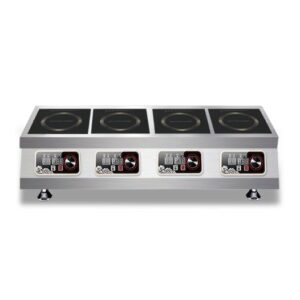
4-Zone Induction Cooktop IND-04
Code: GN10326

4-Zone Induction Cooktop IND-44
Code: GN10325

Induction Cooktop 4 Burners + Shelf IND-4
Code: GN10324
Recommended 6-burner models (for heavy loads):
- IND-06 Maximum output during the peak hours of service.
- IND-6 (+ shelf) A top-class professional station for large venues (hotels, banquet halls).
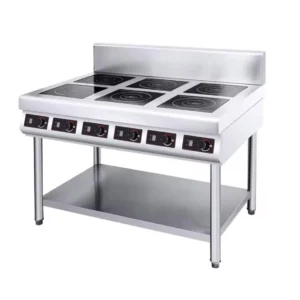
Induction Cooker with 6 Burners + Shelf IND-6
Code: GN10323
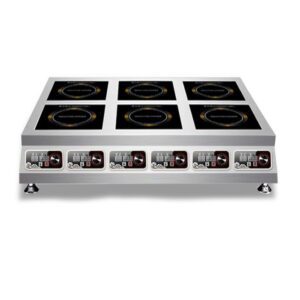
6-Burner Induction Cooktop IND-06
Code: GN10322
3. Real HORECA cases (case studies)
To see the practical benefit of induction cooktops more clearly, let us look at two typical scenarios from the reality of Georgian restaurants.
Case #1: a premium open-kitchen café in Tbilisi
- The problem: The client had an open kitchen, where guests can see the cooking process. The traditional gas range created excess noise, soot and heat, which made the guests in the dining room uncomfortable. On top of that, it was not visually attractive.
- The solution: The client bought the Induction Cooktop 4 Burners + Shelf IND-4 (GN10324).
- The result: The kitchen became perfectly clean. Service speed rose by 20% (thanks to water and stocks boiling faster). For customers the cooking process became a “show”, with no noise and no smell.
Case #2: an Asian takeaway restaurant
- The problem: Demand for wok dishes (noodles, rice) grew large. Cooks working on a gas wok tired quickly because of the high temperature, while the gas bill was disproportionately large.
- The solution: The venue replaced the traditional unit with two IND-W induction wok cooktops (GN10320).
- The result: The temperature in the kitchen dropped noticeably and the staff’s ability to work improved. Energy costs fell by 35%, and thanks to precise temperature control the quality of the dish (the caramelisation of the sauce) became identical and consistent every time.
4. Specifications and comparison matrix (GN.GE models)
Here is a simplified table to help you make the right decision:
| Type of venue / load | Recommended model | Number of burners | Additional feature | Price (₾) | Main advantage |
| Small bar / bakery | IND-02 (GN10329) | 2 | Countertop | 720 ₾ | Compactness and ergonomics |
| Asian street food | IND-002 (GN10321) | 1 (Wok) | Recessed surface | 355 ₾ | Fast searing and focused heat |
| Medium restaurant | IND-44 (GN10325) | 4 | Independent control | 1,680 ₾ | High output in a standard space |
| Large restaurant (high vol.) | IND-4 with shelf (GN10324) | 4 | Integrated shelf | 2,430 ₾ | Equipment storage, easy hygiene |
| Hotel / banquet | IND-6 with shelf (GN10323) | 6 | Integrated shelf | 3,260 ₾ | Highest power, multitasking |
5. Care: how to extend the life of the cooktop?
Although induction surfaces (usually glass ceramic) are very tough, they still need to be used correctly. In a professional kitchen, equipment breaking down is as good as a disaster.
Daily hygiene (what to do):
- Clean it when cool: Wait until the surface has cooled down completely. Use only a soft microfibre cloth and a cleaning fluid made for glass ceramic.
- Removing grease: Grease does not burn onto an induction surface (because the glass itself does not get fiercely hot), but hot liquid boiling over from a pot still leaves a mark. It is best removed with a damp soft sponge as soon as service ends.
What you must never do! (the red lines):
- Spilling sugar and caramel: If a sugary mass (syrup, for example) is spilled on the surface and dries, it can damage the structure of the glass ceramic. It must be cleaned off immediately with a special blade scraper while it is still warm.
- Sliding heavy pots across the surface: Cooks are in the habit of sliding a pot or pan back and forth to change the temperature (as they do on gas). On induction this damages and scratches the surface. You have to lift the pan and set it down instead.
- Abrasive cleaners: Never use a metal scourer or coarse powders (a bleach-type formulation, for instance).
- Thermal shock: Do not pour cold water on a scorching surface in order to clean it.
6. Compatible cookware – the “magnet test”
The most important thing to know when switching to an induction cooktop is whether your equipment is compatible. Since the technology is based on an electromagnetic field, the base of the pan has to be magnetic.
- What works: Cast iron, magnetic stainless steel (18/0, the 430 series), enamelled iron.
- What does not work: Aluminium, copper, glass, ceramic, non-magnetic stainless steel (18/10) — unless they have a special induction base built in.
A professional’s tip: Before you buy new pots, simply take an ordinary magnet (even a fridge magnet) and hold it against the outside of the base of your existing pan. If the magnet sticks firmly — the pan is ideal for induction!
7. The main technical advantages of induction cooktops (summary)
To draw things to a close, let us sum up the specifications that make this technology irreplaceable:
- Precision: You can set the temperature exactly. Need to melt chocolate at 45°C? Or simmer a stock slowly? Induction guarantees it without any bain-marie.
- Smart pan detection: The cooktop works only while a pan is standing on it. As soon as you lift the pan off, energy consumption stops. That rules out the problem of “gas burning for nothing”, which is common in busy kitchens.
- Hygiene and HACCP: A flat, smooth surface rules out bacteria and dirt building up in corners and in burner heads. Meeting HACCP standards is far simpler.
- Safety for chefs: No open flame = no risk of burns, gas leaks or clothing catching fire.
An investment in quality and technology
Buying a professional induction cooktop is not simply an equipment upgrade — it is a strategic business decision that starts reducing your utility costs from the very first month and increases the throughput of the kitchen.
Whether you are opening a small, cosy café, a sushi bar or an enormous banqueting space, the range available on GN.GE(from induction woks through to 6-burner industrial stations) lets you find exactly what you need.
Ready to take your kitchen to a new level?
Browse our full catalogue of induction cooktops now and contact us for a free consultation. Our experts will help you choose the best option for the specifics of your business!