 KA
KA EN
EN RU
RU

 Back to Blog
 September 5, 2026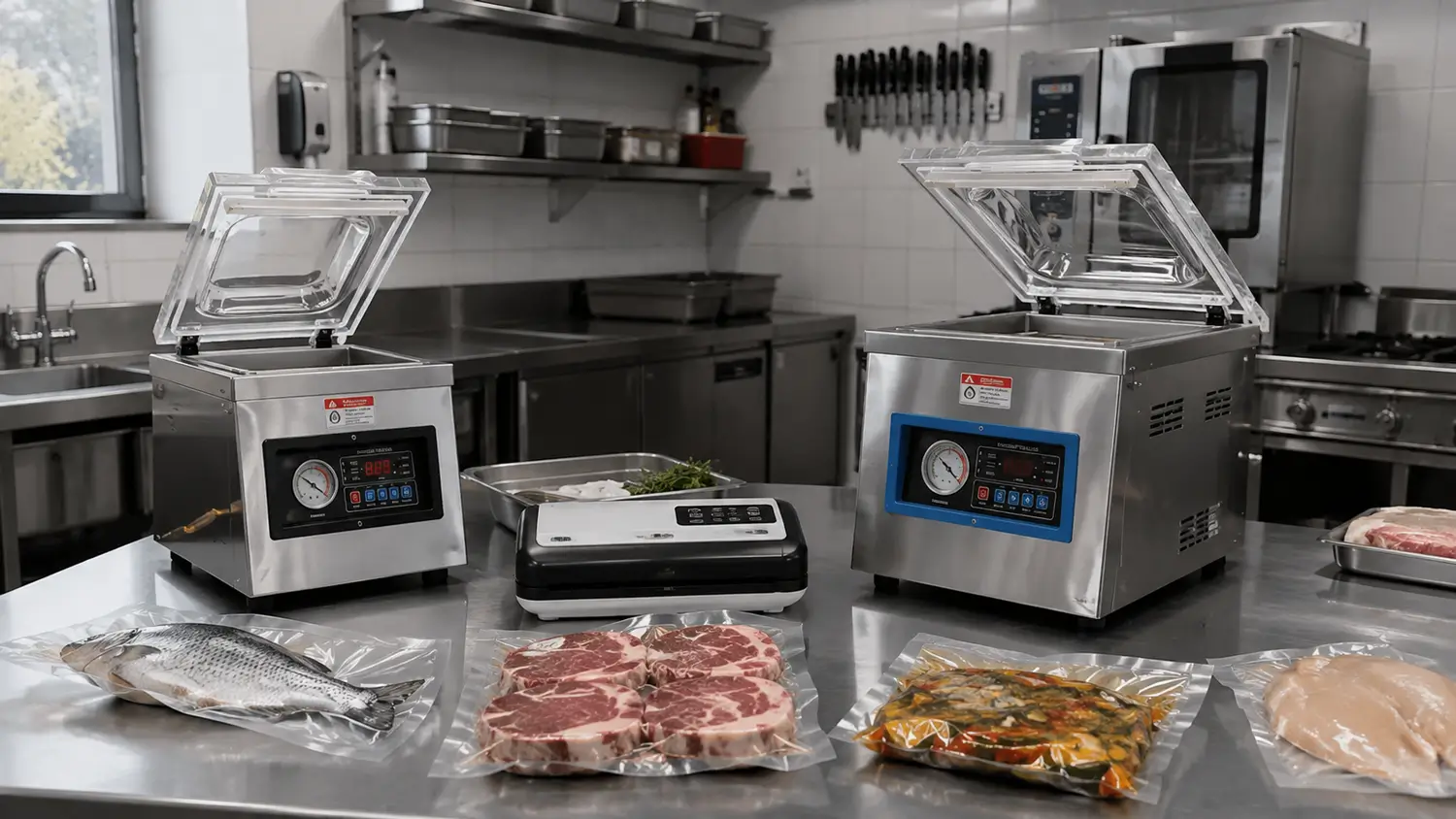
In the modern restaurant and food-production business, one of the biggest challenges is managing food waste. Raw ingredients stored incorrectly quickly lose weight, colour and flavour, and end up in the bin. The most effective, scientifically proven and practical way to solve this problem is vacuum packaging technology.
Where vacuum packing machines were once found only in large meat plants, today they are an inseparable part of any successful restaurant, café or small production facility. In this long, practical article we look in detail at why a vacuum packing machine is a strategic investment, how to choose the ideal model from our range, and how to extend its working life.
1. Why does your business need a vacuum packing machine? (ROI and practical benefits)
Buying a vacuum packing machine is not just a sign of good taste — it is a straightforward economic calculation. Let us translate the benefits of this equipment into figures and practical advantages:
- Shelf life extended 3-5 times: The absence of oxygen stops aerobic bacteria from multiplying. For example, where fresh meat lasts 3-4 days in an ordinary refrigerator, under vacuum it stays fresh for up to 10-14 days.
- Keeping the product’s weight and cutting losses: A product kept in a refrigerator (meat and cheese especially) dehydrates — it dries out and loses 3-5% of its weight. A vacuum-packed product retains 100% of its weight and moisture.
- The chance to buy wholesale: A vacuum packing machine lets you buy raw ingredients in large volumes (which is far cheaper), portion them and store them for a long time with no risk of spoilage whatsoever.
- Isolating aromas: Keeping fish, cheese and meat together in a refrigerator often means smells transfer between them. Vacuum packaging is hermetic, which rules out cross-contamination completely.
- Sous-vide technology: In modern restaurants, preparing premium-quality steaks and dishes is unthinkable without sous-vide — and vacuum packing is its very foundation.
2. The technological difference: universal vs chamber vacuum packing machines
The catalogue offers two main types of technology. Telling them apart is critically important for making the right choice.
2.1. Universal, chamber-free vacuum sealer (e.g. GNV30)
Machines of this type have no internal chamber. The open end of the bag is placed in the mouth of the machine, which draws the air straight out of the bag.
- Advantage: Compactness (the GNV30 weighs just 2.4 kg), mobility, a low price. Ideal for dry products and for small everyday packaging jobs.
- Limitation: It is difficult to vacuum products containing liquid (marinades, soups), because the pump may draw the liquid in as well.
2.2. Chamber-type vacuum packing machines (the DZ series)
This is the professional standard. The bag with the product inside is placed entirely within the machine’s internal chamber. The machine pumps the air out of the whole chamber and not just out of the bag. Because the pressure is equalised, liquid does not boil and does not spill out of the bag at the moment of sealing.
- Advantage: Ideal for liquids (marinades, sauces), remarkably high power, the highest standard of hermetic sealing.
3. Which model suits which segment? (model analysis)
So that you neither overpay nor end up short of power, the model should be chosen according to the load at your venue.
A. Small venues: cafés, bistros, small markets
If your aim is to vacuum 20-50 portions a day, or to prepare product for sous-vide, tabletop chamber models are ideal. They are compact (they fit on a standard stainless-steel table) and run on a 220V supply.
- DZ260T A 26 cm wide sealing bar. 0.57 kW of power. This is the “golden middle” for small restaurants that want professional quality at minimal cost.
- DZ300T and DZ400T: With 30 and 40 cm sealing bars respectively. The 40 cm model lets you seal 2 or 3 small bags at once, which speeds the work up.
B. Medium and large restaurants, butcheries, small production facilities
Here you need continuous operation, room for large items (whole fish, blocks of meat) and industrial power. In such cases free-standing models are irreplaceable.
- DZ400S A 400 mm sealing bar, a powerful 0.75 kW motor and a 380V (three-phase) supply. The 90-kilogram body keeps vibration to a minimum.
- DZ500S An extra-wide 50 cm bar and a 52x52x7.5 cm chamber. If you work with large items (big wheels of cheese, a whole pork leg), this model is exactly the one for you.
C. Large industry: meat plants, fish production, large-scale distribution
Time is money. When it comes to packing product by the tonne, idle time for the operator is unacceptable. Double-chamber vacuum packing machines create a continuous production chain.
- DZ400/2C and DZ500/2C The principle is simple: while air is being pumped out of the left chamber (which takes 15-20 seconds), the operator loads the next batch into the right chamber. That doubles the throughput of the facility. With its 1.5 kW pump, the DZ500/2C is the most powerful unit in our catalogue.
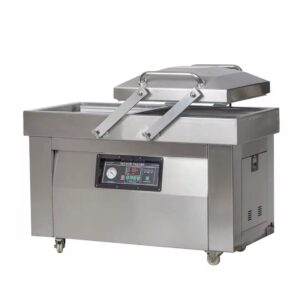
Vacuum machine DZ400/2C
Code: DZ400/2C
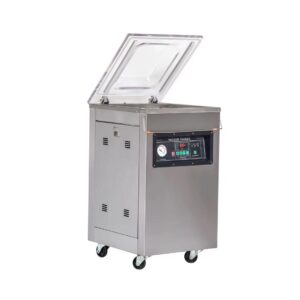
Vacuum Machine Dz500s
Code: DZ500S
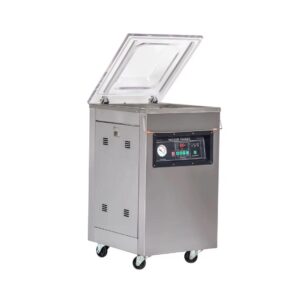
Vacuum Packaging Machine Dz400s
Code: DZ400S
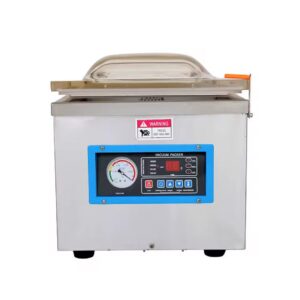
Vacuum Sealer Dz260t
Code: DZ260T

Vacuum Sealer Dz400t - 40 Cm Sealing Width
Code: DZ400T

Vacuum Sealer Dz300t – 30 Cm Sealing Width
Code: DZ300T
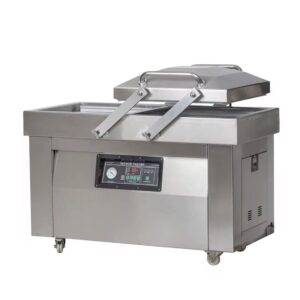
Vacuum machine DZ500/2C
Code: DZ500/2C
4. Comparison matrix: find your model
To make it clearer, here is a technical comparison of the models:
| Model code | Type / construction | Sealing width | Power / supply | Ideal for |
| GNV30 | Universal, chamber-free | 30 cm | 220V | Home use / small café, dry product |
| DZ260T | Tabletop chamber | 26 cm | 0.57 kW / 220V | Small restaurant, sous-vide, liquids |
| DZ400T | Tabletop chamber | 40 cm | 0.75 kW / 220V | Medium restaurant, ergonomics |
| DZ500S | Floor-standing, single chamber | 50 cm | 0.85 kW / 380V | Large restaurants, large cuts (meat) |
| DZ500/2C | Floor-standing, double chamber | 50 cm | 1.5 kW / 380V | Factories, industrial production |
5. A look at practical cases (case studies)
Case #1: a restaurant (meat focus)
- The problem: The restaurant was preparing premium steaks. When it bought a large batch of meat (at a discount), part of it dried out and lost colour through oxidation, which led guests to complain. The marinating process took 12-24 hours.
- The solution: They bought the DZ300T.
- The result: They cut the meat into portions, place it in a bag together with the marinade and vacuum it. The vacuum pressure opens the pores of the meat and the marinade is absorbed within minutes (instead of 24 hours). Shelf life tripled and waste fell to zero. The investment paid for itself in 2 months.
Case #2: a small cheese producer
- The problem: They were making cheese that soon grew mouldy in distribution (on shop shelves) and lost its appearance.
- The solution: They moved to an DZ400S industrial model with a 380V supply.
- The result: The cheese is packed hermetically in 40 cm bags. Returns from the retail chains stopped. The product took on a premium look, which allowed them to raise their selling price by 15%.
6. Care: how to look after the machine?
Professional machines (the DZ series) are fairly robust, but they do require basic technical routines. The vacuum pump is the “heart” of this equipment.
- Checking and changing the oil: The pump of a chamber machine runs on oil. At the back of the machine (or inside it) there is a transparent window. The oil should be clean and clear. If the oil has turned white (milky) or black, it means moisture has got into it and it must be changed at once. Changing the oil is simple and is recommended once every one or two months under intensive use.
- Wear of the Teflon and the nichrome: The sealing bar is covered with a special protective layer (Teflon), beneath which the conducting element (nichrome) runs. Over time it burns out. If you notice that bags seal poorly or that the Teflon has blackened, it should be replaced.
- Cleanliness in the chamber: Never leave spilt liquid or blood in the vacuum chamber. Clean it at the end of the shift so that the pump does not draw foreign liquid in during the pumping process.
7. Summary
The vacuum packaging system long ago outgrew the framework of simple “packaging equipment” — it is the most powerful instrument there is for optimising a business, for culinary precision (sous-vide) and for financial savings. GN Industrial offers only the highest-quality, proven and dependable models with a 3-year warranty and full technical support.
Choose quality and turn your kitchen into a true industrial standard.
Which model best matches the specifics of your production — a compact tabletop unit or a powerful double-chamber system? Get in touch and our experts will help you make the final choice!