 KA
KA EN
EN RU
RU

 Back to Blog
 July 25, 2026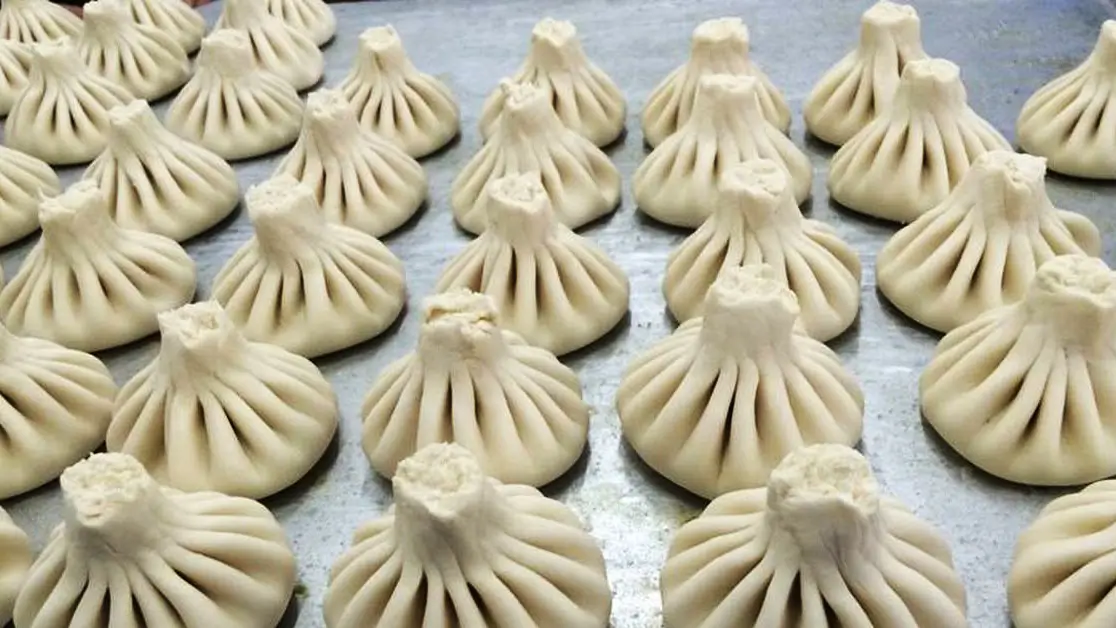
Professional khinkali machines are one of the most important investments in the Georgian food industry. For restaurants and khinkali shops, khinkali is the highest-margin and most in-demand product, however, the main obstacle to business growth is the low productivity of manual labor.
As demand increases, kneading, rolling, and shaping dough by hand leads to staff fatigue, order delays, and, most importantly, inconsistent quality. The only solution to this problem is kitchen mechanization.
In this complete guide, we will discuss in detail how to build a khinkali production line based on the size and budget of your business, what criteria to use to select equipment, and how to calculate the exact return on investment (ROI) time.
The choice of equipment directly depends on the type of your facility and daily throughput. If you misjudge demand, you may end up paying for equipment that is too powerful, or vice versa — the equipment may not be able to handle the load during peak hours.
The table below presents the types of businesses, critical bottleneck stages, and the minimum equipment you need to optimize the process:
| Business type | Daily productivity | Critical Interruption Stage | Minimum equipment set |
| Small dining room | 200 – 500 pieces | Flattening, cooking speed | Tabletop planer (HNM), 15L mixer, 40-50L boiler |
| Restaurant | 500 – 1,500 pieces | Rubbing, cooking during peak hours | 50L mixer, heavy duty screed, 70-100L boiler |
| Hotel | 300 – 800 pieces | Staff time, standard | Compact mixer, HNM-240, professional kettle |
| Catering / Dark Kitchen | 1,000 – 2,500 pieces | Cutting and standardization of plates | Semi-automatic press, 50L mixer, powerful boiler |
| Semi-finished products workshop | 3,000 – 10,000+ pieces | Plate cutting and forming speed | Automatic plate making machine, 50-70L mixer |
| Supermarket enterprise | 2,000 – 5,000 pieces | Continuous processing of raw materials | YMZD series press, industrial boiler, dough mixer |
Industrial or restaurant production of khinkali is divided into 5 main technological stages. Each stage requires specific equipment to minimize the defect rate.
- Kneading and preparing the minced meat: Khinkali dough is characterized by low water content and high density. At this stage , dough and minced meat mixers with a powerful motor are used.
- Primary Dough Rolling: The dough is processed in a khinkali dough rolling machine . The rollers ensure a perfectly even thickness of the dough, which is critical to ensure that the khinkali does not crack during cooking.
- Plate receiving/pressing: The already rolled mass is transferred to dough presses or automatic plate cutting machines, where rings of the same diameter and weight are obtained.
- Forming (rolling): Dosing the minced meat and rolling the plates. In small and medium-sized facilities, this process is performed manually, and in large factories – with special forming machines.
- Boiling: The final stage, which requires high-power khinkali boiling pots . Water should be abundant so that the temperature is restored instantly.
As mentioned, khinkali dough quickly wears out standard pastry mixers due to the excessive load on the motor. When choosing a specialized mixer, you should consider the volume of the tank, the material of the body (stainless steel is a must), and whether it can be used for both dough and minced meat.
HR-J15 vs HR-J50 — Which one is right for you?
| Parameter | HR-J15 | HR-J50 |
| Tank capacity | 15 liters | 50 liters |
| Maximum dough loading | 4 – 6 kg | 15 – 20 kg |
| Engine power | 0.75 kW | 2.2 kW |
| Voltage | 220V | 220V / 380V |
| Recommended business | Small dining room | Large restaurant, manufacturing |
A dough sheeter is the most affordable and effective way to reduce manual labor. HNM series dough sheeters feature an adjustable thickness mechanism, which means that the dough thickness is controlled with millimeter precision. This reduces the number of defective, torn khinkali to a minimum.
HNM Series Comparison Table
| Model code | Working width | Recommended daily load | Price category |
| HNM-180 | 180 mm | 300 – 500 khinkali | Basic (from 410 ₾) |
| HNM-200 | 200 mm | 500 – 800 khinkali | Standard |
| HNM-220 | 220 mm | 800 – 1,200 khinkali | Enhanced |
| HNM-240 | 240 mm | 1,200 – 2,000 khinkali | Flagship |
Positioning: Starting at 410 GEL, this is the most affordable entry into mechanized production, which pays for itself in the first month through savings in staff time.
When a business moves beyond restaurant scale and moves to semi-finished products (or very heavy-duty khinkali), a tabletop flattener is no longer enough. In such cases, heavy-duty floor presses and automatic plate machines are required.
Comparison of YMZD and TDRMJ series
| Model | Type | Productivity (kg/h) | Engine power |
| TDRMJ-350 | Semi-automatic press | 60 – 80 kg/h | 1.5 kW |
| YMZD350 | Industrial dough press | 100 – 120 kg/h | 2.2 kW |
| YMZD500 | Heavy duty production press | 180 – 250 kg/h | 3.0 kW |
TDDW-2 — Automatic Plate Making Machine
If your goal is to fully automate the plate cutting stage, the TDDW-2 model automatically cuts a continuous strip of dough into khinkali plates (cups) of ideal shape and precise weight. This machine simultaneously replaces 3-4 workers and eliminates excess dough waste.
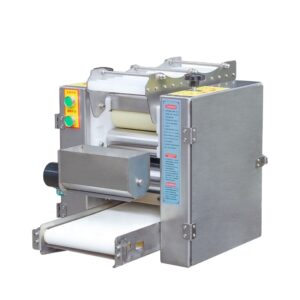
Khinkali plate making machine TDDW-2
Code: TDDW-2
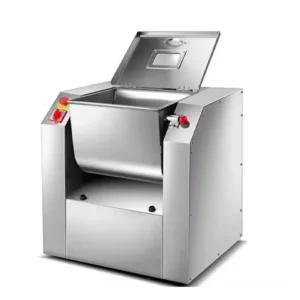
Horizontal mixer HR-J50
Code: HR-J50
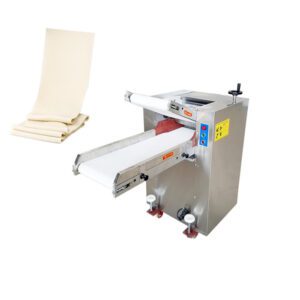
Khinkali Dough Press TDRMJ-350
Code: GN20ST6895-AU
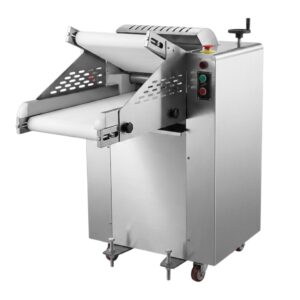
Khinkali dough press YMZD350
Code: YMZD350
Khinkali dough press YMZD500
Code: YMZD500
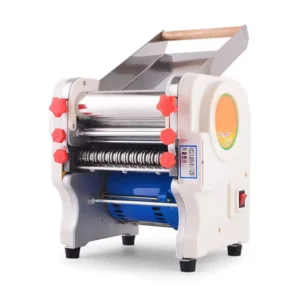
Khinkali Dough Roller HNM-240
Code: HNM-240
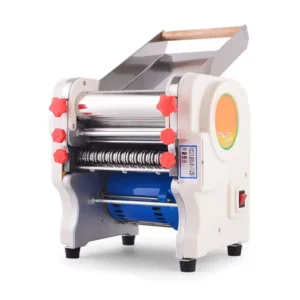
Khinkali dough rolling machine HNM-180
Code: HNM-180
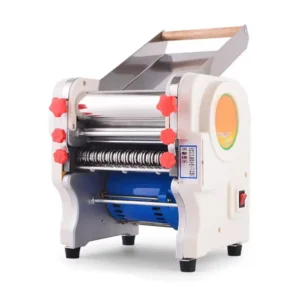
Khinkali Dough Roller HNM-200
Code: HNM-200
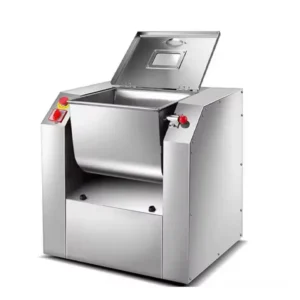
Horizontal mixer HR-J15 – with stainless steel body
Code: HR-J15
A boiling pot is the engine of a professional kitchen. Khinkali technology requires a large mass of boiling water — when we put cold khinkali in the pot, the water temperature drops. If the pot does not have the proper power and volume, the water will not boil in time, and the khinkali will stick to the bottom.
What to consider when choosing a boiler:
- Water volume: Determines how many servings you can cook at once.
- Basket system: Allows you to remove the khinkali from the water in one go, which speeds up serving.
- Steel grade: AISI 304 stainless steel is necessary to prevent corrosion in salty environments.
- Filling and emptying system: taps for easy water changes.
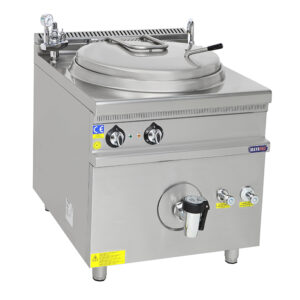
Khinkali cooking pot 150lt electric M-KTE 890
Code: M-KTE 890
Khinkali cooking pot 70lt electric M-KTE 870
Code: M-KTE 870
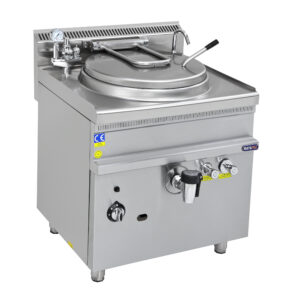
Khinkali cooking pot on gas 150 lt. M-KTG 890
Code: M-KTG 890
Khinkali cooking pot on gas 70 lt. M-KTG 870
Code: M-KTG 870
The most common question that restaurateurs ask: which energy carrier should we choose for the boiler?
| Criterion | Electric boilers (e.g. M-KTE series) | Gas boilers (e.g. M-KTG series) |
| Installation | Requires 380V (three-phase) network | Requires natural gas and a powerful exhaust fan |
| Operating cost | Medium / High (depending on the tariff) | Low (natural gas is cheaper) |
| Heating speed | Stable, thermostatically controlled | Very fast, with powerful burners |
| Safety | Fewer fire regulations | Requires gas safety protection |
| Mobility | Relatively easy to move | Connected to the central gas pipe |
Conclusion and recommendation:
If your facility has gas wiring and proper ventilation, a gas boiler (for example, M-KTG 870 or 890) is much more economical in the long run and will significantly reduce your utility costs. However, if only three-phase electricity is available at the facility or if gas is difficult to install due to safety regulations, an electric boiler (M-KTE 870 / 890) is an ideal and safe alternative.
Choosing the wrong boiler size is the most common mistake. Never buy a boiler based solely on “average” load — it should be able to handle peak hours (for example, Friday and Saturday evenings).
Simple calculation formula:
Required boiler capacity (liters) = (peak hourly demand ÷ number of cycles per hour) × 1.25 (resource coefficient)
Example:
If you have to serve 300 khinkali during peak hours, and 1 full cooking cycle takes 15 minutes (4 cycles per hour), you should cook at least 75 khinkali at a time. 75 khinkali require about 90-100 liters of water to cook comfortably. Accordingly, a 70-liter boiler will be small for you, and you should opt for a 150-liter model.
To simplify your decision-making, we have compiled 3 optimal sets of equipment. Their purchase fully covers all stages of khinkali production:
- Starter set (for small khinkali): includes HNM-180 tabletop flattener, 15-liter mixer, and KAPP compact boiler. Ideal for 300-500 khinkali per day. (Total cost ≈ 2,971 ₾).
- Standard set (for traditional restaurants): combines the HNM-240 flagship flattener, a 50-liter mixer, and a 70-liter professional boiler. Withstands a load of 1,000-1,500 khinkali per day. (Total cost ≈ 14,990 ₾).
- Production set (for semi-finished products workshops): includes TDDW-2 automatic plate machine, industrial press (YMZD500), 50-liter mixer and 150-liter gas boiler for maximum productivity. (Total cost ≈ 26,130 ₾).
The money paid for the mechanization is a direct investment that will pay you back over time. Let’s consider an example of the return on investment for a medium-duty restaurant (in the case of purchasing a standard set):
| Indicator | Hand-made (2 chefs) | Mechanized production (“Standard”) |
| Initial investment in equipment | 0 ₾ | 14,990 ₾ |
| Staff salary (monthly) | 3,000 ₾ (2 × 1,500 ₾) | 1,500 ₾ (1 cook-operator) |
| Daily performance limit | ~500 – 600 pieces | 1,500+ pieces |
| Defective product share | 5% – 8% | < 1% (stable thickness) |
| Savings from salary (per month) | — | 1,500 ₾ |
| Savings from raw material waste | — | ~400 ₾ |
| Estimated return on investment (ROI) | — | 7 – 8 months |
The viability of professional equipment depends on its proper maintenance.
Maintenance checklist:
- Daily: Clean the screed rollers and mixer tank at the end of the working day. Use only a soft cloth, not metal brushes, to avoid scratching the surface.
- Weekly: Check moving parts and mechanisms.
- Monthly: Clean the boiler heating elements (heaters) from scale.
5 most common mistakes that void the warranty:
- Forcing very dry, rock-hard dough through a rolling pin.
- Turning on the boiler without water (which instantly burns away moisture).
- Installation of a 380V unit in an unstable network, without phase protection.
- Washing the equipment with a high-pressure water jet (Kärcher) directly on the engine or electrical unit.
- Ignoring timely replacement of lubricants in heavy equipment gearboxes.
All our equipment is made of high-quality stainless steel and fully complies with HACCP and the hygiene standards of the National Food Agency.
Before you make a final decision, check these 7 points:
- Capacity limit: Calculate the maximum load on a peak day.
- Workspace: Measure the kitchen area and make sure there is proper exhaust ventilation above the stove.
- Infrastructure: Check if you have 380V three-phase electricity or adequate gas pressure.
- Material: Make sure the unit is completely stainless steel.
- Parts supplies: Only work with a company that has spare parts in Georgia.
- Warranty: Request an official warranty terms document.
- Scalability: Always purchase equipment with a 20-30% performance reserve so that you don’t have to buy new equipment as your business grows.
gn.ge is the official partner of leading brands in the HORECA sector (including MAYAPAZ, KAPP, etc.) in Georgia. By cooperating with us, you receive:
- Official warranty on all major components of the device.
- Fast delivery and installation throughout Georgia.
- Technical service and parts directly from our Tbilisi warehouse, which eliminates waiting for weeks in the event of a breakdown.
- Flexible financial terms: business installments, leasing, and complete B2B invoicing for legal entities.
How much does a khinkali machine cost?
Prices start at 410 GEL (small tabletop flattener) and go up to over 13,800 GEL (industrial 150-liter boilers). A complete set for a small business costs about 3,000 GEL.
Which boiler is better — electric or gas?
If the facility has gas wiring and a powerful exhaust fan, a gas boiler is more economical in terms of operating costs. An electric boiler is easy to install, but requires a 380V network.
How many khinkali are made in a 150 liter pot?
A 150-liter pot can comfortably cook 100 to 120 khinkali at a time.
Does the equipment need 380V?
Tabletop grinders and 15-liter mixers operate on standard 220V. 70+ liter electric kettles and industrial presses definitely require 380V.
Is there an installment plan?
Yes, we offer both traditional business installment financing and leasing services through partner banks.
What is the warranty on the equipment?
The product is covered by a 1-year official warranty, which includes free service and replacement of parts in the event of a factory defect.
Where can I get spare parts?
Spare parts for all popular models are available in the gn.ge warehouse, ensuring the continuity of your business.
Can I use a mixer for mincing as well?
Yes, HR-J series mixers are universal and are designed for kneading both dense dough and minced meat.
Will I learn how to operate the machine?
Our technical team thoroughly instructs and trains personnel on the proper use of the equipment during the installation process.
Mechanization of a khinkali production line is not a luxury — it is a necessity for a business that wants to maintain stable quality, increase customer satisfaction, and optimize personnel costs. Despite the initial investment, properly selected equipment pays for itself in a very short time.
See Complete catalog of khinkali machines and choose the best models for your business!