 KA
 EN
 RU


 Back to Blog
 October 17, 2026
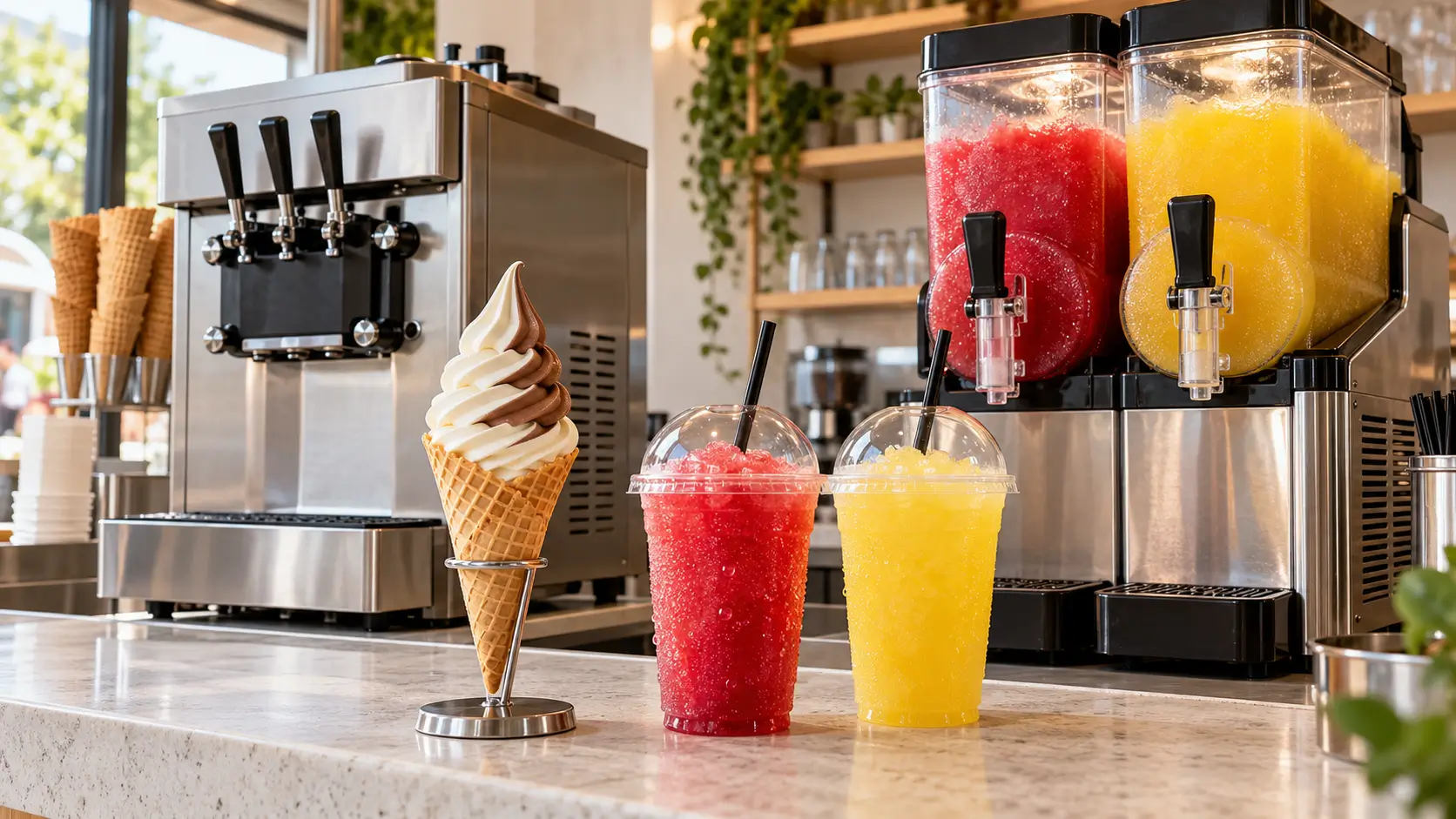
At first glance, selling ice cream and slush looks like a simple business: the machine makes the product, a staff member fills the cup, and the customer is on their way within a few minutes. Behind that simplicity, however, lie several important decisions — where the outlet will be located, how many servings will sell, how much will be left at the end of the day, and what it will cost to keep the machine running properly.
This line of business has good commercial potential: you can start with a small range, standardize the service process and round out an existing menu. Profit, however, depends on how well demand, costs and service capacity match one another.
In this article we look at the soft-serve ice cream and slush business from two angles: as an add-on line in an existing café, bar or hotel, and as a small stand-alone outlet. The financial examples will help us see under what conditions the investment is justified and where more caution is needed.
What creates the opportunity in this business
Ice cream and slush are often impulse purchases. The customer sees the product, weighs the price, the weather and their own craving, and decides on the spot. That is why visibility, a clear menu and an easy buying process are directly linked to sales.
In an existing food-service outlet, these products can raise the average check. An ice cream bought after a meal or a cold drink added to the main order generates extra revenue in a space where the customer already is. The result, however, is not measured by sales of the new product alone: if a guest bought a slush instead of another, more profitable drink, the additional profit will be lower than expected.
A small range also makes the work easier. Two well-chosen flavors, a defined serving size and a workstation prepared in advance help staff serve orders consistently. Adding many flavors, on the other hand, can increase stock and waste without significantly changing sales.
For a hotel, a cold dessert is sometimes part of the guest experience. If the product is included in a meal package and not sold separately, its effect should be judged by guest satisfaction and cost per guest. In that case, a café’s retail sales model cannot be applied directly.
Location: how many people pass by and how many will buy
A busy location does not automatically make a successful point of sale. What matters is who moves through the area, when they have time to stop, and how easily they notice the offer. A passer-by hurrying to catch public transport and a family out for a stroll are different customers.
When assessing a location, observe it over several weekdays and days off. Note the foot traffic in the morning, at midday and in the evening; compare sunny days with cooler ones. Separately assess access, the space needed for a queue, prices at neighboring businesses, and whether your menu can be seen from the direction in which customers are moving.
When assessing the competition, don’t just count similar machines. Ice cream, lemonade, iced coffee and other desserts may all be competing for the same money from the customer. Work out what you will offer better: a more convenient purchase, a distinctive flavor, consistent quality or a serving size suited to a specific audience. Permanent discounts cannot replace an answer to this question.
A first estimate of demand can be simple. If a given stretch has 200 relevant passers-by per hour and, for the sake of the calculation, we assume that 3% of them buy the product, we get six purchases per hour. This is a hypothetical example, not an industry average. The real share should be established through on-site observation and trial sales.
Seasonality also varies by location. An open-air promenade may depend more on the weather than an indoor entertainment center. The peak period at a tourist spot and the sales of a neighborhood café serving local customers need to be planned differently. One strong summer week cannot serve as a measure of demand for the whole year.
Before signing a lease, work out how you will operate in the slow months: will you cut hours, change the range or close temporarily? Keep in mind that even if you close, rent, storage and technical preparation costs may remain.
Ice cream and slush: a similar format with different specifics
Soft-serve ice cream: flavor, texture and portion weight
The quality of soft-serve ice cream is determined by the mix, correct machine setup and consistent dispensing. What matters to the customer is that today’s ice cream is just as tasty and just as smooth as on their previous visit.
When choosing a mix, compare ready-to-use liquid bases with powders that need to be made up: how each is stored, what it requires once opened, how easy it is to prepare and how many servings you actually get. Cheap ingredients do not always mean a low cost price if the product is often rejected or more is lost during preparation.
During freezing, air is worked into the mix and the volume of the finished product increases. That is why liters of mix and liters of ice cream served are not the same thing. The principle of this volume increase is also explained in Taylor’s technical guide. In practice, calculate the cost price from the yield your own recipe delivers and by measuring portions.
If the planned portion is 100 grams but a staff member consistently serves 120 grams, ice cream usage per portion rises by 20%. The cost of the cup stays the same, but the ingredient budget has already been blown. In the early stages, periodic weighing is the simplest way to spot this difference.

Ice cream machine AS-Z100
Code: AS-Z100

Ice cream machine CY-8238H
Code: GN20ST4078-AU

Ice cream machine CY-828T
Code: GN20ST6327-AU

Ice cream machine CY828
Code: GN20ST6326-AU

Ice cream machine AS-ZT965
Code: AS-ZT965
Slush: recipe and freezing time
Slush is a semi-frozen drink whose quality depends on correct dilution and an even crystalline texture. Arbitrarily changing the ratio of concentrate to water changes not only the taste but also the freezing process.
To choose a suitable mix and preparation method, follow the ingredient manufacturer’s instructions and the machine manual. For example, BUNN’s technical manual focuses on concentration, thorough pre-mixing and chilling the mix. One manufacturer’s parameters do not apply to every machine. Sugar-free drinks, too, should only be made with the appropriate recipe and equipment.
When choosing a slush machine, tie the number of flavors to sales. A third tank gives you extra choice, but if that flavor rarely sells, the product sits in the machine longer and cleaning takes more time. To begin with, a limited range makes it easier to study demand.

Slash machine 12X2 SC-2
Code: GN20ST6328-AU
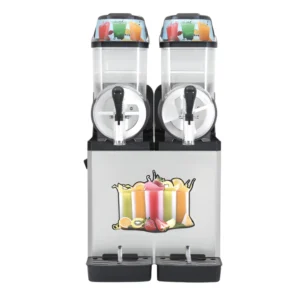
Slash machine 12X2 SM-212
Code: SM-212

Slash machine 12X2 WG212
Code: WG212

Slash Machine 12X3 SC-3
Code: GN20ST6329-AU
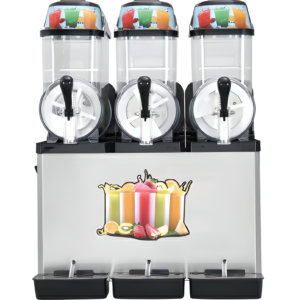
Slash Machine 12X3 SM-312
Code: SM-312

Slash machine 12X3 WG312
Code: WG312
An existing business or a stand-alone outlet
Adding this line to a café has a significant advantage: the space, the customers and part of the infrastructure already exist. The existing refrigerator, till and work surface may even be sufficient. Even so, the costs of the new line should be accounted for separately to show how much it actually adds to the business.
Count the staff member’s additional hours, electricity, cleaning and also the sales that ice cream or slush has taken away from the existing menu. If the machine takes the place of another profitable product, the revenue lost from that space must also be taken into account.
A stand-alone outlet gives you more freedom in layout, menu and branding, but this small range has to cover all the costs. Rent, staff and utilities must be paid even when the weather or foot traffic is not on your side. The owner’s daily work is also a labor cost, even if they don’t pay themselves a salary at first.
Menu and price: more choice doesn’t always mean more sales
Your first menu should let customers grasp the offer quickly and let staff prepare orders in a uniform way. Define the ice cream portion weight, the slush cup size and the extras included in the base price. Offering two sizes can be useful if the difference between them is clear and each size has its own separately calculated cost price.
Toppings and sauces increase the order value, but the extra revenue should also be weighed against their cost and the service time they add. If elaborate decoration slows down the queue, you may lose more in sales than you gain from the extras. At the start, a few simple, predefined options are easier to manage.
In an existing café, also test a combo offer, for example a small slush with a dish. To evaluate the promotion, compare the money left over from the extra sales with the revenue lost to the discount and the additional service cost. If the discount goes to customers who would have bought both products anyway, the promotion reduces profit.
Test a new flavor on a small scale first. Record sales, how difficult it is to prepare and how much mix is left over. A popular name is not reason enough to give it its own tank and permanent stock. A place on the menu should go to a product that customers choose again and again and whose quality the team can maintain consistently.
Choosing equipment for your actual workload
The most useful question is: how many servings will the machine dispense during the period when you have the most customers? Average daily sales may be modest, yet a large share of orders may come within a single hour.
When comparing professional ice cream machines, don’t rely on hourly output alone. Find out under what conditions that figure was obtained, how many servings can be dispensed back to back, and how long the machine needs to return to working consistency after mix is added.
Tank capacity is also a different characteristic from production speed. A large tank holds more mix, but that does not in itself mean faster freezing. For slush, decide in advance how often you will refill: adding a large amount of unchilled mix all at once can prevent orders from being served on time.
If a demonstration is available, make the test resemble the way you will actually work. Use your chosen mix and portion size, serve several orders in a row and watch the consistency. Note the start-up time, the noise and the cleaning process. Simply looking over an empty machine will not give you this information. Also check that there is no difference between the demonstration unit and the configuration you are buying.
Before buying, check the electrical supply, grounding, the installation location and the ventilation clearances required by the manufacturer. An air-cooled machine needs free space to dissipate heat; the exact requirements are given in the documentation for the specific model. In a small outlet, planning the space in advance helps to lay out the queuing, serving and washing zones correctly.
Also consider how easy the machine is to maintain: how many parts come apart, who will train staff to reassemble it, and which consumable parts are needed. For a better grasp of the technical terms, you can read this overview of how ice cream machines work and how to choose one. Make the final choice based on your workload and the documentation for the specific equipment.
Daily operation: hidden costs and quality control
Receiving, preparing and chilling the mix, filling the machine and cleaning are all part of the work process. A staff member’s time is not measured only by serving portions. If these steps don’t fit into the shift, they will either be delayed or require additional pay.
Label opened ingredients and prepared mix with the time they were opened or prepared. Take storage temperatures and shelf life from the manufacturer’s instructions. Check in advance whether your existing refrigerators have enough capacity for the additional stock. Preparing an unlimited amount of mix is no guarantee of fast service.
Overnight storage mode does not replace cleaning. Refrigeration and a heat-treatment cycle are different functions; having one does not mean having the other. Set how often the machine is disassembled, washed and sanitized according to the specific model’s manual and the applicable requirements. This distinction is also pointed out directly in Taylor’s operator manual.
The cleaning plan must be practical to carry out: with suitable products, a defined concentration and a set contact time. Set up work tables and sinks in advance so that clean parts do not come into contact with soiled equipment. Staff must know what to do if storage temperatures are breached or a product looks suspect.
Also take ingredients and allergens into account: milk, the composition of the wafer cones, nut toppings and shared utensils. Answers to customers’ questions must be based on accurate information. A mix of unknown composition or with an unverified storage history is no place for commercial experiments.
Financial calculation: how much is left from sales
The model below presents scenarios for two business formats. The base and strong scenarios for the stand-alone outlet assume higher sales volumes because, in this example, its operation is focused entirely on selling ice cream and slush. All sales, cost prices and operating expenses are hypothetical. Equipment prices are indicative and do not constitute a commercial offer.
Based on the catalog in mid-October 2026, for this example we can allow roughly GEL 5,000–6,500 for a suitable soft-serve ice cream machine and roughly GEL 3,000–3,500 for a two-tank slush machine. Check current prices and configurations in the gn.ge catalog. In the calculation we will use a nominal GEL 9,000 for the two machines.
Initial budget
| Cost item | Adding a line | Stand-alone outlet |
|---|---|---|
| Indicative budget for two machines | 9,000 ₾ | 9,000 ₾ |
| Minor space preparation, connections, signage; for a stand-alone outlet, also the rent deposit | 500 ₾ | 2,750 ₾ |
| Additional refrigerator, work and washing equipment | Already in place | 2,500 ₾ |
| Initial ingredients and packaging | 500 ₾ | 500 ₾ |
| Working capital reserve | 1,000 ₾ | 2,000 ₾ |
| Total nominal investment | 11,000 ₾ | 16,750 ₾ |
The first model assumes that a suitable refrigerator and washing infrastructure are already in place. For the stand-alone outlet, we assume a small, ready-to-use space that needs no major renovation. Roughly GEL 2,500–3,000 is allowed for its minor preparation, connections, signage and the rent deposit; the table uses GEL 2,750 for the calculation. This amount will vary with the condition of the premises and the lease terms. The other costs are likewise only assumptions for this example. The working capital reserve is not money spent on the first day, but it is part of the funding needed to get started.
Unit economics of a single serving
Let’s assume a hypothetical selling price of GEL 5 for ice cream and GEL 4 for slush. These are not average market prices. In the variable cost example we already include ingredients, packaging, an allowance for waste and the payment processing fee.
| Metric | Ice cream | Slush |
|---|---|---|
| Hypothetical selling price | 5.00 ₾ | 4.00 ₾ |
| Ingredients | 0.95 ₾ | 0.45 ₾ |
| Cup or cone, with necessary accessories | 0.30 ₾ | 0.30 ₾ |
| Waste allowance | 0.15 ₾ | 0.17 ₾ |
| Payment processing fee | 0.10 ₾ | 0.08 ₾ |
| Total variable cost | 1.50 ₾ | 1.00 ₾ |
| Amount left to cover fixed costs | 3.50 ₾ | 3.00 ₾ |
The GEL 3.50 left on each ice cream is not net profit. Staff, utilities, maintenance and other obligations still have to be paid out of this amount. Verify the product’s real cost price by preparing a trial batch and counting the saleable portions it yields.
Three scenarios for each business model
Let’s assume 26 working days a month. When the line is added to an existing business, the weak scenario sells 20 ice creams and 20 slushes a day, the base scenario 40 and 40, and the strong scenario 60 and 60. These are numbers of servings; one customer can buy several products.
For the existing outlet, let’s take a nominal GEL 2,200 a month in additional fixed costs: labor — 1,200; utilities — 300; cleaning — 150; technical maintenance — 150; other additional costs — GEL 400.
| Monthly figures: existing outlet | Weak | Base | Strong |
|---|---|---|---|
| Servings sold | 1,040 | 2,080 | 3,120 |
| Revenue | 4,680 ₾ | 9,360 ₾ | 14,040 ₾ |
| Variable costs | 1,300 ₾ | 2,600 ₾ | 3,900 ₾ |
| Additional fixed costs | 2,200 ₾ | 2,200 ₾ | 2,200 ₾ |
| Operating result | 1,180 ₾ | 4,560 ₾ | 7,940 ₾ |
For the stand-alone outlet, the weak scenario again assumes 20 ice creams and 20 slushes a day, the base scenario 58 and 58, and the strong scenario 80 and 80. That puts base sales at 3,016 servings a month and strong sales at 4,160. The higher volume is an assumption of this scenario; actual sales will depend on the location and customer demand.
Let the nominal fixed-cost budget be GEL 6,200 a month: rent — 1,500; labor — 3,200; utilities — 450; cleaning — 200; technical maintenance — 250; other costs — GEL 600. The labor figure should also include the value of the owner’s own work.
| Monthly figures: stand-alone outlet | Weak | Base | Strong |
|---|---|---|---|
| Servings sold | 1,040 | 3,016 | 4,160 |
| Revenue | 4,680 ₾ | 13,572 ₾ | 18,720 ₾ |
| Variable costs | 1,300 ₾ | 3,770 ₾ | 5,200 ₾ |
| Fixed costs | 6,200 ₾ | 6,200 ₾ | 6,200 ₾ |
| Operating result | −2,820 ₾ | 3,602 ₾ | 7,320 ₾ |
The tables show how each format’s result changes as sales grow. The base and strong scenarios for the stand-alone outlet assume more sales, but its fixed costs are also higher. So when assessing the results, consider both sales volume and cost structure. To simplify the calculation, labor and utility costs are kept constant; in a real budget, adjust them to the workload. Strong sales may also call for an additional staff member.
The results in the tables are calculated without taxes, loan interest or depreciation. Check the impact of VAT on revenue and the relevant costs with your accountant and adjust the model accordingly. The amounts shown should not be read as after-tax profit.
How many servings cover the costs
With equal sales of ice cream and slush, the average serving leaves GEL 3.25 to cover fixed costs. Hence:
Daily minimum = monthly fixed costs ÷ working days ÷ average amount left per serving.
Under these assumptions, the existing outlet needs about 27 servings a day and the stand-alone outlet about 74. This is only the threshold for covering the costs included in the model. Taxes, financing costs and a different product mix will change it. If realistically achievable sales barely exceed this threshold, the business will have limited resources to withstand even a minor setback.
ROI and payback period
ROI compares net profit for a chosen period with the investment:
ROI = net profit for the period ÷ initial investment × 100%.
For example, if a GEL 16,750 investment yields a hypothetical full-year net profit of GEL 6,000 after all relevant costs, the annual ROI will be about 35.8%. This is a separate illustrative example; such an annual result does not follow from the monthly scenarios above.
The payback period shows how long it will take the business to return the money invested. This requires calculating the cash flow left after taxes, restocking and other essential payments. The operating result shown in the tables does not automatically equal this amount.
Calculate month by month how much cash is left after all essential payments and add these amounts up cumulatively. The investment is recovered when the accumulated balance equals the amount initially invested. Depreciation is not an actual cash outflow, so it is not deducted as a separate payment when calculating cash flow. A few busy months a year do not add up to twelve equally profitable months; for these two formats, naming a single payback period would not be justified.
In your annual plan, list the active season, the transitional months and the weakest period separately. Assign each of them its working days, sales, staff hours and rent. Then see how much money you will need until sales pick up. Even a business that is profitable over the year can run short of cash right before the season starts, when stock and the restart of operations have to be financed.
The working capital reserve should be determined from this schedule. The GEL 1,000 and 2,000 used in the table are only part of the example; they do not represent a sufficient amount for every outlet. If the business is financed with a loan, include loan principal repayments in the cash flow plan as well, even though they are not an operating expense.
Key risks and how to reduce them
Weak demand and bad weather. Test your financial plan against a drop in sales as well. In the stand-alone outlet’s base scenario, a 20% fall in sales cuts the monthly operating result from GEL 3,602 to about GEL 1,642, all other conditions being equal. This shows how sensitive the result is to changes in volume.
Rising ingredient costs and waste. If the variable cost of an average serving rises by GEL 0.20, the stand-alone outlet’s base scenario of 3,016 servings will leave about GEL 603 less per month. So, along with prices, periodically review recipes, portions, packaging and the product written off at the end of the day.
Equipment downtime. The cost of a breakdown includes lost sales, possibly spoiled mix and the time it takes to get back up and running. Before buying, find out how to contact service, how diagnostics are handled and whether spare parts are available. Read the warranty terms in advance: the warranty period, what service is covered and the exclusions are separate matters.
Inconsistent quality. An untrained employee, incorrect dilution or oversized portions damage both the customer experience and the financial result at the same time. Written recipes, clear instructions and periodic checks make results easier to repeat.
What to check before investing and after launch
Before investing, prepare a single working document: customer and location; three sales scenarios; portion size and cost price; the full startup budget; staff schedule; cleaning and technical maintenance plan. Also check the food business registration and hygiene requirements that apply to your type of operation.
If possible, test demand with a limited range first. In an existing outlet, it is especially important to find out whether the result of the business as a whole has improved. The popularity of an additional product does not in itself prove additional profit.
Once you are up and running, record daily sales by product and by hour, revenue, mix used, waste and machine downtime. Periodically check portion weights and the hours spent on the work as well. These records will show you where it is worth changing the range, where to add staff and where to prepare less mix.
When evaluating results, don’t just look at the cash register total. Sales may grow while the amount left over shrinks because of oversized portions, discounts and ingredient waste. Several weeks of data calculated the same way will help you tell a one-off success from a repeatable result. Make changes one at a time and on a small scale so you can see their effect.
Before deciding to buy, you should have two figures in hand: the daily sales your observations support, and the minimum sales that cover your full costs. The gap between them will show how well your chosen business model can withstand a slow period.