 KA
 EN
 RU


 Back to Blog
 October 23, 2026
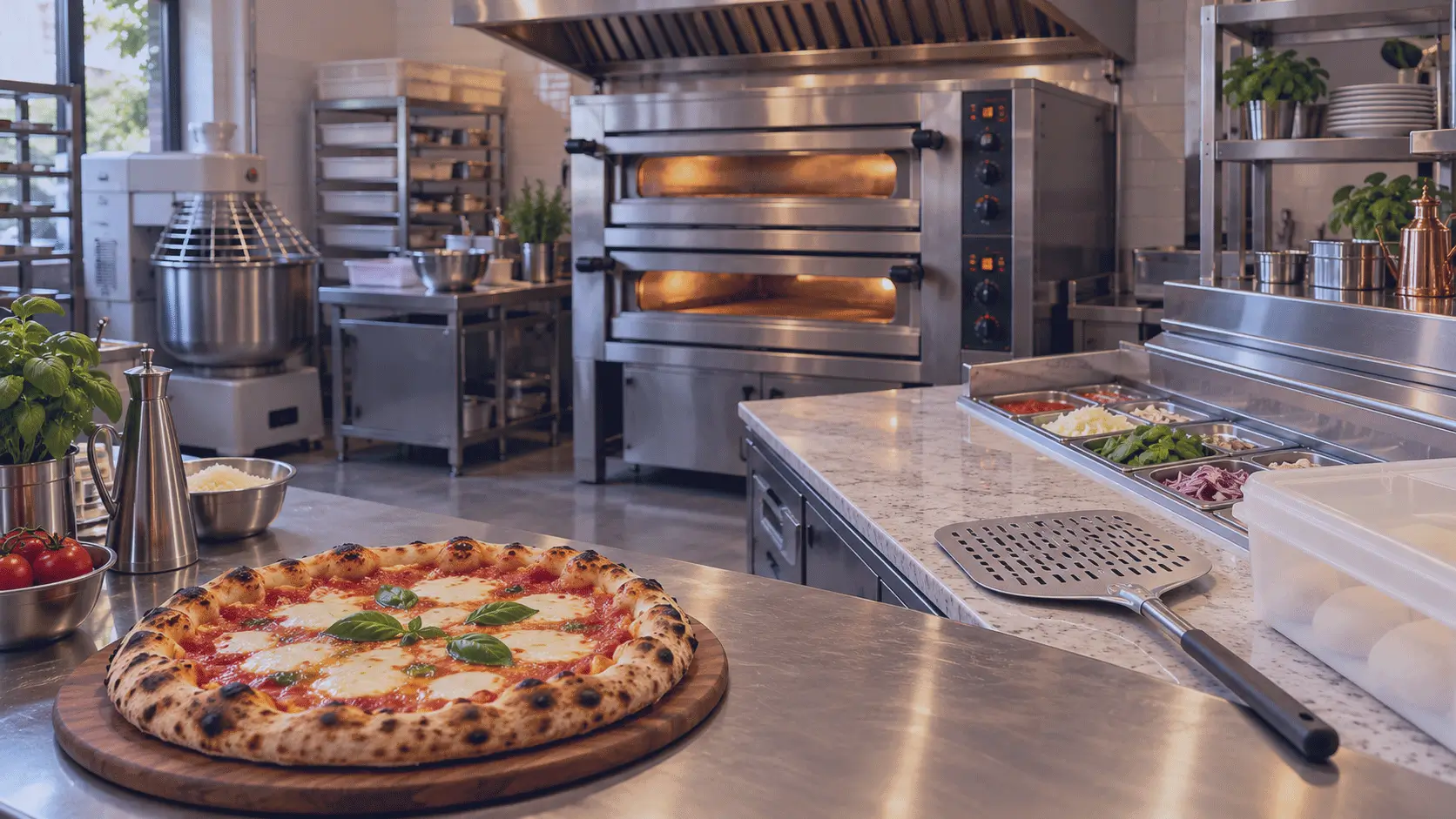
Opening a pizzeria starts with a decision: what product you will offer customers and how you will get it to them. A small outlet that works mainly on delivery needs a different space, team and work schedule than a pizzeria where guests dine in. This choice also determines the starting budget and the equipment you need.
When planning, the menu, dough preparation process, refrigerated storage and baking capacity have to be aligned with one another. For example, if you make dough in advance and rest it in the refrigerator, you need to account for the volume of batches stored at the same time. If most orders come in during the evening, choose the oven based on the load during exactly that period.
In this guide we look at the eight main stages of opening a pizzeria: from drawing up a business plan to fitting out the space, and from choosing equipment to taking the first orders and day-to-day management.
1. Pizzeria format, market research and business plan
At the first stage, decide how your pizzeria will operate. For dine-in service you need to plan the dining room, furniture, tableware and front-of-house staff. A takeaway-focused outlet needs a convenient entrance and an order pickup point. In the delivery model, the service area, courier access and product quality after transport require particular attention.
If you choose a mixed format, decide in advance how orders arriving at the same time from the dining room and from online channels will be handled. The kitchen’s capacity must match the combined load of orders from all channels.
Study your customers and competitors
Choose a likely location and observe who buys food in the area: employees of nearby offices, students, families or evening visitors. Compare competitors’ menus, pizza sizes, prices, ordering terms and customer reviews.
The aim of this research is to understand what will make your offer appealing to a specific audience. The difference may lie in the pizza style, consistent quality, convenient ordering or a menu your team can execute well.
What goes into the budget for opening a pizzeria
Calculate the costs of opening a pizzeria based on the specific premises, menu and scale of operation. The following breakdown will help you put together your starting budget:
| Cost group | What to consider |
|---|---|
| Premises and preparation | Lease deposit, renovation, electrical wiring, water, sewerage and ventilation |
| Equipment | Oven, dough mixer, refrigerators, work tables, installation and small utensils |
| Service and sales | Order tracking, payment methods and, if needed, dining room furniture and tableware |
| Opening stock | Ingredients, pizza boxes, other packaging and cleaning supplies |
| Launch marketing | Product photography, menu preparation and an initial advertising campaign |
| Working capital | Covering running costs during the period when sales have not yet reached the planned level |
When comparing equipment quotes, check whether the price includes taxes, transport, installation and the necessary accessories. Set aside a separate reserve in the budget for unforeseen work.
A pizzeria business plan should show how much you keep from each order after covering its direct costs. Subtract the cost of ingredients, packaging, applicable commissions and other variable costs from the sale amount. What remains has to cover rent, staff pay and other fixed costs; only after that can you talk about profit.
Draw up low, medium and high sales scenarios. In each one, estimate the number of orders, the average check and costs. This way you will see in advance what volume the business needs to cover its costs and how well that matches the kitchen’s capacity.
2. Choosing a location and planning the space
When assessing a location, let your service format guide you. For dine-in service, consider visibility, access and a comfortable environment for customers. If you work on delivery, assess how convenient it is to serve your target neighborhoods from the chosen address at different times of day.
Before signing the lease, check the following together with a technical specialist:
- the available electrical capacity and the power supply required by the selected equipment;
- where needed, the conditions for gas supply and for installing the corresponding equipment;
- whether an extraction system can be installed, and the supply of fresh air;
- water supply, hot water and sewerage;
- the dimensions of the doors and passageways for bringing in equipment, and of the work area;
- a place for couriers to wait and for orders to be handed over.
Agree on the necessary alterations with the property owner in advance. If the space needs significant ventilation or electrical work, this work must be included in the opening budget and timeline.
How to lay out the kitchen work zones
Build the layout around the flow of product: receiving, storage, dough preparation, pizza assembly, baking and dispatch. Plan a separate area for washing and waste management. The layout should reduce the chance of clean utensils, finished products and contaminated materials coming into contact with one another.
Position the work tables so that staff do not constantly have to walk to the other end of the kitchen to fetch ingredients. Leave space next to the oven for loading and unloading pizzas safely, and set up the dispatch area for checking and packing orders.
Give dough storage particular attention. Work out the number and size of containers from your work schedule. The refrigerator’s total capacity in liters alone will not tell you how many of the boxes you need will fit inside.
3. Registration and food safety
Before opening the pizzeria, choose the legal form of your business and settle your tax accounting arrangements. The relevant food-related activity must also be registered in the Register of Economic Activities. Check the registration of the company or individual entrepreneur and the registration of the activity separately: the Food Code prohibits a business operator from operating without registration.
How to determine whether HACCP is required
HACCP is a system for assessing and controlling food safety hazards. Whether you are obliged to implement it depends on the type of activity and the relevant status.
Under an amendment in force since July 20, 2025, a catering establishment that prepares and supplies ready-to-eat food to the final consumer and has small business status is not required to implement HACCP. This refers to the status defined by law; a small floor area does not by itself qualify a business for the exemption. Confirm the requirements that apply to your activity with the National Food Agency before opening.
This exemption does not lift the obligation to follow hygiene rules. Define procedures in advance for receiving and storing raw materials, cleaning, disinfection, pest control and staff hygiene. Keep supplier details and goods receipt documents so that you can trace the origin of raw materials when needed.
Prepare clear allergen information for every menu item. Check the composition of the dough, cheese, sauces and other compound ingredients, and take into account the possibility of unintentional allergen cross-contact in the kitchen. Every relevant team member should be able to answer a customer’s question.
4. Pizzeria equipment and essential tools
Choose your pizzeria equipment based on the menu and the planned workload. The key question is whether the kitchen will be able to prepare orders on time when several customers order at once.
That is why the oven, dough mixer, refrigerated storage and prep area should be assessed together. You will not benefit from a large oven if the team cannot keep up with assembling pizzas or you do not have enough dough on hand.
4.1. Pizza oven
Start choosing a pizza oven with the pizza style and diameter. Then assess the desired baking mode, the number of orders expected at peak hours and the electricity or gas available on the premises.
For a deck oven, what matters is the size of the baking chamber, the baking surface and the heat control options. When choosing a conveyor model, assess the conveyor size, the belt speed control and the result you get with your recipe. In both cases, the choice must fit your specific workflow.
Simultaneous capacity and hourly output are different figures. Be sure to check what pizza diameter the stated quantity is based on. The output published by the manufacturer can also vary with pizza size.
For your work plan, also take into account loading, unloading, the baking cycle and packing. Ask the supplier how the selected model performs under continuous load and whether it can be tested with your recipe.
Before buying, check the external dimensions, installation clearances, ventilation requirements, cleaning procedure and service terms. To explore different models, see GN Industrial’s pizza ovens.

Pizza Oven 9 Pizza INOXCLASS
Code: GN1073

Pizza Oven 9+9 Pizza INOXCLASS
Code: GN1072

İnoxclass 4+4 Pizza Oven
Code: GN1069

Pizza Oven İnoxclass 6 Pizzas
Code: GN1067

Pizza Oven İnoxclass 6+6 Pizza
Code: GN1068

Gas Pizza Oven İnoxclass 4+4 Pizza
Code: GN10132

Gas pizza oven INOXCLASS 6 pizzas
Code: GN1071

Gas Pizza Oven İnoxclass 6+6 Pizza
Code: GN10133
4.2. Dough preparation equipment
Choose a dough mixer for a pizzeria based on the dough mass needed per mixing cycle and the number of batches planned over the day. For regular pizza dough production, consider spiral models. If you are looking at a planetary mixer, check in the manual whether the specific model is suitable for your dough and what load it allows.
In the specifications, distinguish between:
- bowl volume in liters;
- maximum flour quantity in kilograms;
- maximum finished dough weight in kilograms.
Bowl volume is not the same as finished dough capacity. When assessing the load, the recipe also has to be taken into account, since a different ratio of water to flour changes the mixing conditions. Follow the technical data of the specific model.
For example, if you use 280 grams of dough per pizza, 100 pizzas will need 28 kilograms of dough in total. This is only an illustrative example. Next you need to decide in how many batches you will make this quantity and where you will store it until baking.
Decide whether you need a dough sheeter based on the pizza style and shaping method. Before buying, test whether the resulting thickness and edge shape suit your product.
To compare models, see dough mixers and kneaders.
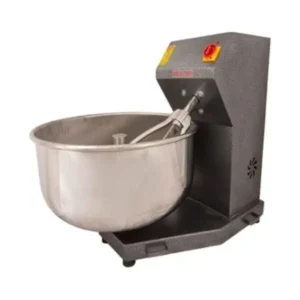
DM-7 Dough Mixer – 7 kg capacity, 32 cm
Code: GN1001

Professional dough mixer DM-15 – 15 kg, with stainless steel body
Code: GN1002

Professional dough mixer DM-20 – for 20 kg of dough
Code: GN20ST0039

Dough mixer 30 kg – 220V power supply
Code: GN1004

Dough mixer DM-20 – 20 kg, 220V
Code: GN1003
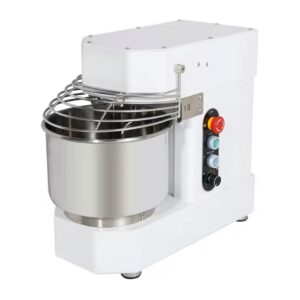
Spiral mixer S10
Code: S10
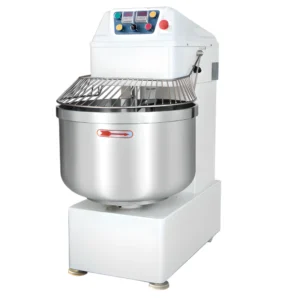
Spiral mixer H80 – with 80 liter bowl, 380V
Code: H80
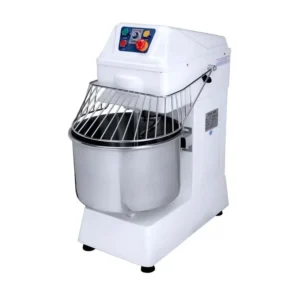
Spiral mixer H60 – with 64 liter bowl, 220V
Code: H60

Spiral mixer H50 – with 54 liter bowl and 220V power supply
Code: H50
4.3. Refrigeration and prep area
Refrigerated storage must be sufficient both for ingredients and for the dough batches your work schedule calls for. When choosing the capacity, take into account delivery frequency, container sizes and the amount of product stored at the same time.
A refrigerated pizza prep counter combines a work surface with refrigerated storage. This setup lets you keep the ingredients you need close to the pizza assembly station, although the capacity of a prep counter may not be enough for the whole outlet’s stock.
Compare the size of the work surface, the layout of doors and drawers, compatibility with containers and ease of cleaning. Separately assess whether you need an additional refrigerator or freezer.
Set storage conditions according to the requirements of each specific product and the supplier’s instructions. A temperature range given in the equipment’s technical description does not mean a setting that is equally suitable for every ingredient.

Pizza table refrigerator with 2 doors ICEINOX PTS – with granite surface
Code: GN20ST0410
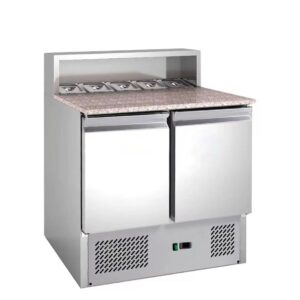
Pizza table refrigerator with 2 doors PS900
Code: PS900
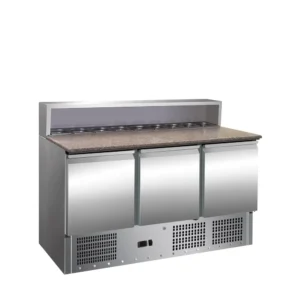
Pizza table refrigerator PS-903 – 3 doors
Code: PS903

Pizza table refrigerator PS300
Code: PS300

Pizza table refrigerator ICEINOX PTSL 515 – 3 doors
Code: N-GN20ST5098-AU
4.4. Ancillary equipment
In addition to the main equipment, have the following ready for opening: work tables, appropriate sinks, a handwashing station, scales, dough containers, pizza peels, cutters and the trays or screens your baking method requires.
In the packing area, set aside space for boxes, for checking orders and for handing them over to couriers. For dine-in service, also plan the process for washing dishes and storing clean tableware.
Buy additional automation when your workload shows a need for it. At opening, give priority to the set of equipment that lets you prepare your chosen menu safely, consistently and on time.
5. Menu, ingredients and suppliers
Put together your opening menu so that you can prepare every dish to a high standard and manage the stock of ingredients it requires. Several different pizzas can share common ingredients. This makes stock planning easier, especially while you do not yet know the actual sales mix.
Define sizes, dough portions, topping options and packaging in advance. If you make pizzas in several sizes at once, test the baking mode and oven placement for each of them.
Create recipe cards
For each pizza, prepare a card listing the exact quantities of ingredients, the preparation sequence, the baking mode, the final size and the portion cost. It should serve as the team’s shared work instruction.
When calculating cost, also account for the losses that occur during preparation. The purchased weight and the usable quantity do not always match. When an ingredient’s price changes, update the relevant cards and check how the amount left from each sale changes.
Plan dough production and supplies
Along with the dough recipe, write out a work schedule: when the dough is mixed, when it is divided into portions, how it is stored and when it is prepared for baking. Test the fermentation time and temperature with your recipe and in your working conditions, and record the results. It is not worth applying the same regime to every type of dough.
When evaluating a supplier, consider not only price but also consistency of product quality, delivery schedule, packaging and the relevant documentation. Test alternative options for flour, cheese and sauce in advance, so that a supply disruption does not force an unexpected change to your product.
Label incoming stock with the necessary dates and storage information. Match the order of use to the expiry dates and check actual stock levels periodically.
6. Hiring staff and work standards
Determine the size of the team based on opening hours and the expected workload. In a small pizzeria one employee may handle several tasks, but every process must have someone responsible for it.
Set out who makes the dough, who controls stock, who assembles and bakes the pizza, who takes orders and who checks them before dispatch. During peak hours, pay particular attention to passing on the order number, pizza size and extra toppings correctly.
Run training using the recipe cards and the same equipment the team will work on. Staff should know how to use the equipment safely, the cleaning sequence, product storage rules and how to respond to customer comments.
Hold a trial working day
Before the official opening, process several trial orders at the same time. Use different sizes, different pizzas and packaging options. Measure the time from taking an order to handing it over.
Watch where queues build up: at the assembly table, at the oven or during packing. Based on these observations, change the layout, the allocation of duties or the menu. Before taking on more staff, find out whether the problem lies in how the workflow is organized.
7. Marketing and sales channels
Before opening, prepare a clear menu, photos of the real product and a smooth order-taking process. Customers should easily understand the pizza size, ingredients, price, extra options and ordering terms.
If the pizzeria offers dine-in or takeaway service, list the address, opening hours and contact details accurately online. For delivery, clearly state the service area and the estimated delivery time, taking into account the kitchen’s actual workload and travel time.
Choose your order channels
You can take orders on site, by phone, through your own website or via delivery platforms. Calculate the relevant service cost for each channel and decide who will monitor incoming orders.
When working with a delivery partner, review the terms for commission, promotion funding, settlements and order cancellations in advance. An offer that is profitable in one channel can produce a different result in another.
Match your opening offer to your capacity
Set the scale and duration of the opening promotion so that the team can cope with the orders it brings in. Calculate the discount against the cost price and prepare the necessary dough, ingredients and packaging in advance.
On social media, show your product and how it is made. Post photos that reflect the real size and ingredients. Use customer reviews to understand what people like and where the service needs improvement.
When evaluating advertising, look at orders and repeat purchases. Also check how much it cost you to attract a new customer and how much was left from their order after the relevant costs.
8. Day-to-day management and growth
After opening, compare the business plan with actual data. Assess different days and hours separately, so that you know when you need more dough, ingredients or staff.
Monitor the following regularly:
- number of orders and average check;
- sales by menu item and by channel;
- order preparation and dispatch times;
- ingredient usage, remaining stock and written-off products;
- recurring customer comments and order errors.
Update the dough production schedule using the data you have accumulated. Making the same quantity every day can leave you short on busy days and with leftovers on quiet ones.
If you deliver, also assess the pizza after packing and transport. Run test deliveries and check how the product looks when it reaches the customer. If needed, change the packaging, assembly or delivery area.
Plan equipment maintenance according to the manufacturer’s instructions. Decide in advance whom you will contact in case of a breakdown and how you will handle orders during downtime.
Tie a new oven, an additional refrigerator or a menu expansion to a specific need. If orders are getting held up at the oven, look into increasing baking capacity. If the problem is ingredient prep, review that area and how the team is allocated first.
Pre-opening checklist for a pizzeria
- The format, target customer and opening menu have been defined.
- The investment, running costs and required working capital have been calculated.
- The technical capabilities of the premises have been checked and alterations agreed.
- The relevant registration and food safety requirements have been confirmed.
- Equipment has been selected based on the menu, dough schedule and peak load.
- Recipe cards have been prepared and supplies arranged.
- The team knows its duties and hygiene procedures.
- Order taking, preparation, packing and dispatch have been tested.
Frequently asked questions about opening a pizzeria
How much does it cost to open a pizzeria?
The amount depends on the condition of the premises, the format, the menu and the equipment. To work it out, collect quotes for renovation, equipment and installation, then add opening stock and working capital. The price of the oven and dough mixer alone does not reflect the full opening budget.
What equipment does a small pizzeria need?
The basic set includes a pizza oven, a dough mixer suited to your process, enough refrigerated storage, work tables, appropriate facilities for washing and handwashing, scales and ancillary tools. The final list depends on the menu and the workflow.
Can you open a pizzeria without a dining room?
You can choose a takeaway, delivery or combined format. Even then you need to plan the kitchen, storage, washing, packing and pickup area, with the appropriate hygiene and technical conditions.
How do you calculate the number of orders needed to cover costs?
If a positive amount remains from one order after subtracting variable costs, divide your monthly fixed costs by this average amount. The result is the approximate number of orders you need. In the calculation, use the real mix of different pizzas, order sizes and sales channels, and update the result periodically.